|

Author's Bio: Antonio Faillace
Antonio is a huge Disney fan since childhood and has been playing trading card games from a very young age. Therefore, Disney Lorcana was the perfect combination for him. Since the game's release, Antonio has been passionate about Disney Lorcana and has shared that passion with the Brazilian player community through his articles.
|
Hello, everyone!
After our DLC recap (which you can
check out here if you haven't read it yet), today we're taking a closer look at the ink combinations and archetypes that stood out during the tournament!
We'll break down the overall metagame for both Day 1 and Day 2, highlighting the biggest trends and the decks that achieved the greatest success throughout the event.
CORE CONSTRUCTED FORMAT
Before we begin, it's worth remembering that the format played at the DLC was
Core Constructed, meaning that Sets 5 through 12 were legal:
• Set 5:
Shimmering Skies• Set 6:
Azurite Sea• Set 7:
Archazia's Island• Set 8:
Reign of Jafar• Set 9:
Fabled• Set 10:
Whispers in the Well• Set 11:
Winterspell• Set 12:
Wilds UnknownWilds Unknown was the only new addition compared to the previous DLC, held on April 25–26. However, the set undoubtedly introduced several important tools that reshaped parts of the metagame, as we'll see below.
DAY 1 – A WIDE VARIETY OF ARCHETYPES, BUT ONE CLEAR FAVORITE
One of the most rewarding aspects of the first day of competition, on Saturday, was seeing that even with a well-established metagame, Illumineers continued to experiment and innovate.
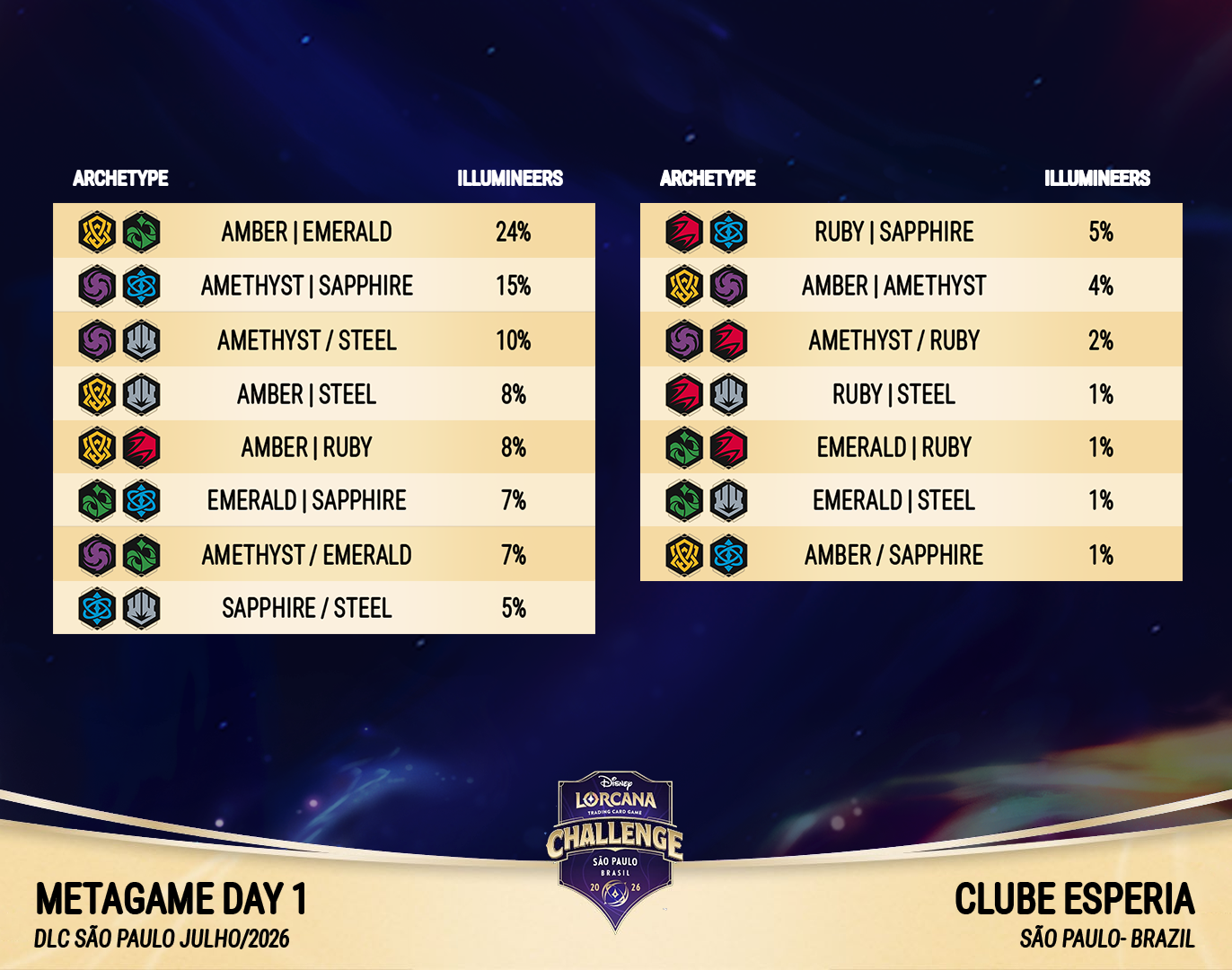
Every ink combination was represented at the event, although one clearly stood out as the community favorite:
The
Amber-Emerald combination, represented primarily by variations of the
Dogs archetype, was without question the favorite among
Illumineers, making up nearly one
out of every four participants at the DLC.
Its combination of
speed and
consistency certainly contributed to its popularity. It was also the deck that won the previous Brazilian DLC, naturally drawing even more attention from competitive players.
Another impressive point is that it remained the most popular ink combination across both Brazilian DLCs (check out our analysis of the April DLC metagame
clicking here). Even though the archetype is well-known and firmly established, no deck appears to have emerged as a true counter to
Dogs, allowing it to maintain nearly the same level of popularity between the two events.
Of course, popularity alone isn't everything—competitive decks are ultimately measured by their
consistency. So let's take a look at what happened on Day 2.
DAY 2 – SEPARATING THE TOP PERFORMERS
To qualify for Day 2,
Illumineers needed to earn 18 points during the first eight rounds. Since each round awards three points, players had to score 18 out of a possible 24 points—or 75% of the total available.
In practice, qualifying required at least
six wins in eight rounds, making Day 2 an excellent snapshot of the tournament's strongest-performing decks.
Let's take a look at the Day 2 metagame:
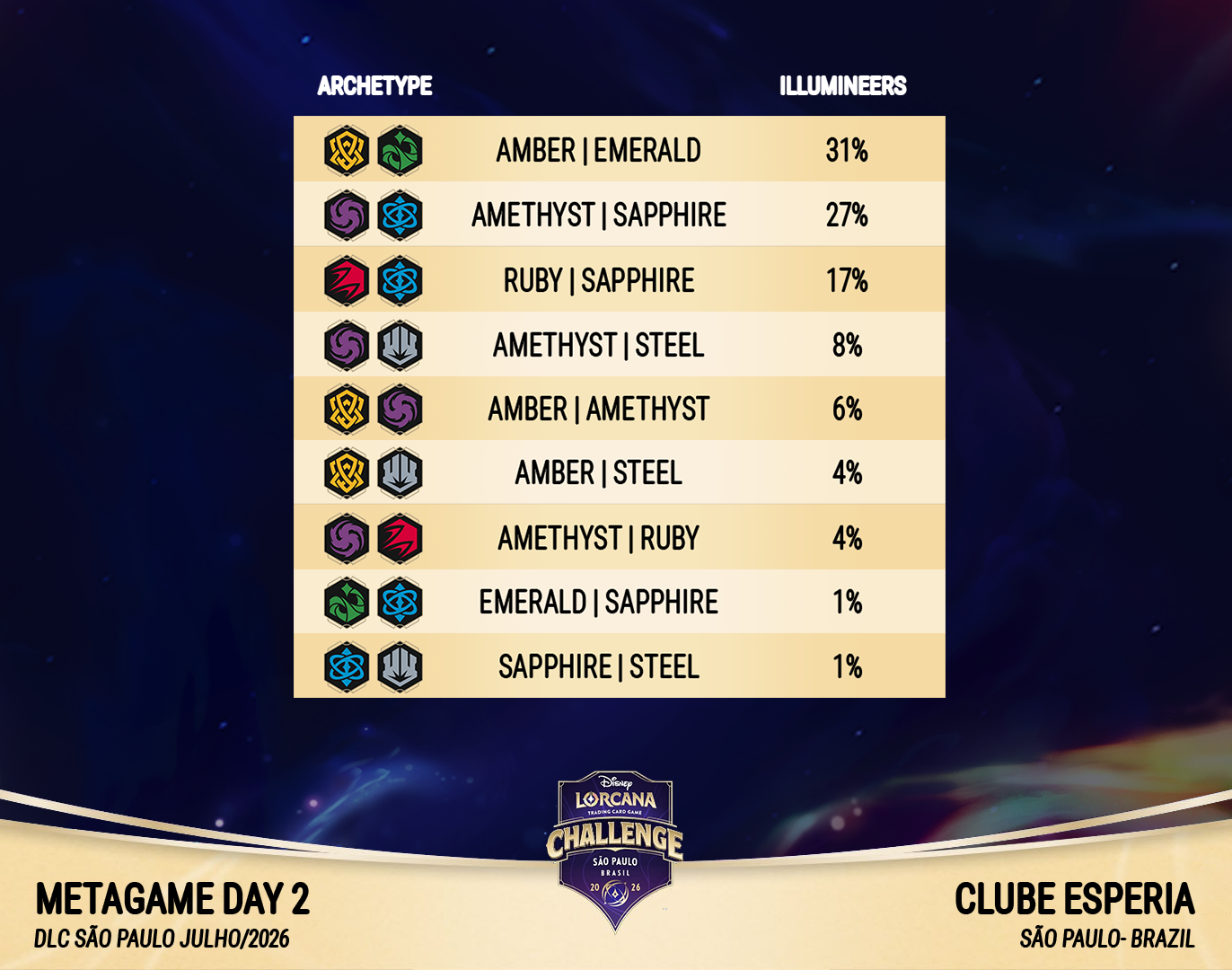
The chart above gives us a clear picture of the
standout decks from this DLC.
Unsurprisingly,
Amber-Emerald remained on top, proving that
Dogs combines both popularity and competitive consistency. Its share of the field increased significantly, rising from 24% on Day 1 to an incredible 31% on Day 2. As a rough approximation, you could say that the deck went from one out of every
four Illumineers on Day 1 to one out of every
three on Day 2.
But
Amber-Emerald wasn't the only deck to demonstrate its strength!
Amethyst-Sapphire, affectionately known as
Blurple, also showed remarkable consistency, increasing its metagame share from 15% to 27%. It's one of the few archetypes capable of going toe-to-toe with Dogs, making its second-place finish well deserved.
In third place, we had one of the tournament's biggest surprises, and arguably the breakout deck of the event:
Ruby-Sapphire Actions. Here we've grouped together both versions of the deck: one built around the rock star
Powerline, along with a larger package of Songs, and another focused on a higher count of low-cost Actions while dedicating fewer deck slots to characters.
What stands out the most is the deck's dramatic rise in representation. It accounted for only about 5% of the Day 1 metagame - roughly one
out of every twenty Illumineers - but grew to approximately 17% on Day 2, or about
one out of every six players. In other words, it wasn't a widely played or especially popular deck going into the tournament, but it posted an excellent overall win rate, with a significant number of the
Illumineers who chose the archetype successfully advancing to Day 2.
UNDERSTANDING THE METAGAME
We hope today's article helped paint a clear picture of the archetypes that stood out at the July Disney Lorcana Challenge São Paulo and offered some insight into where the metagame is headed.
In our next article, we'll analyze the
championship-winning deck piloted by Chris Oyola, exploring how it adapted to—and ultimately conquered—a metagame filled with other
Dogs decks, as well as archetypes that appeared to have favorable matchups against
Dogs.
Don't forget to like and share this article, and be sure to follow Copag's social media channels so you don't miss any future updates!
See you next time!